Investigate your business.
Not just your documents.
Signals tell you what changed. Ask Composed helps you understand why by searching across conversations, tickets, databases, and files simultaneously.
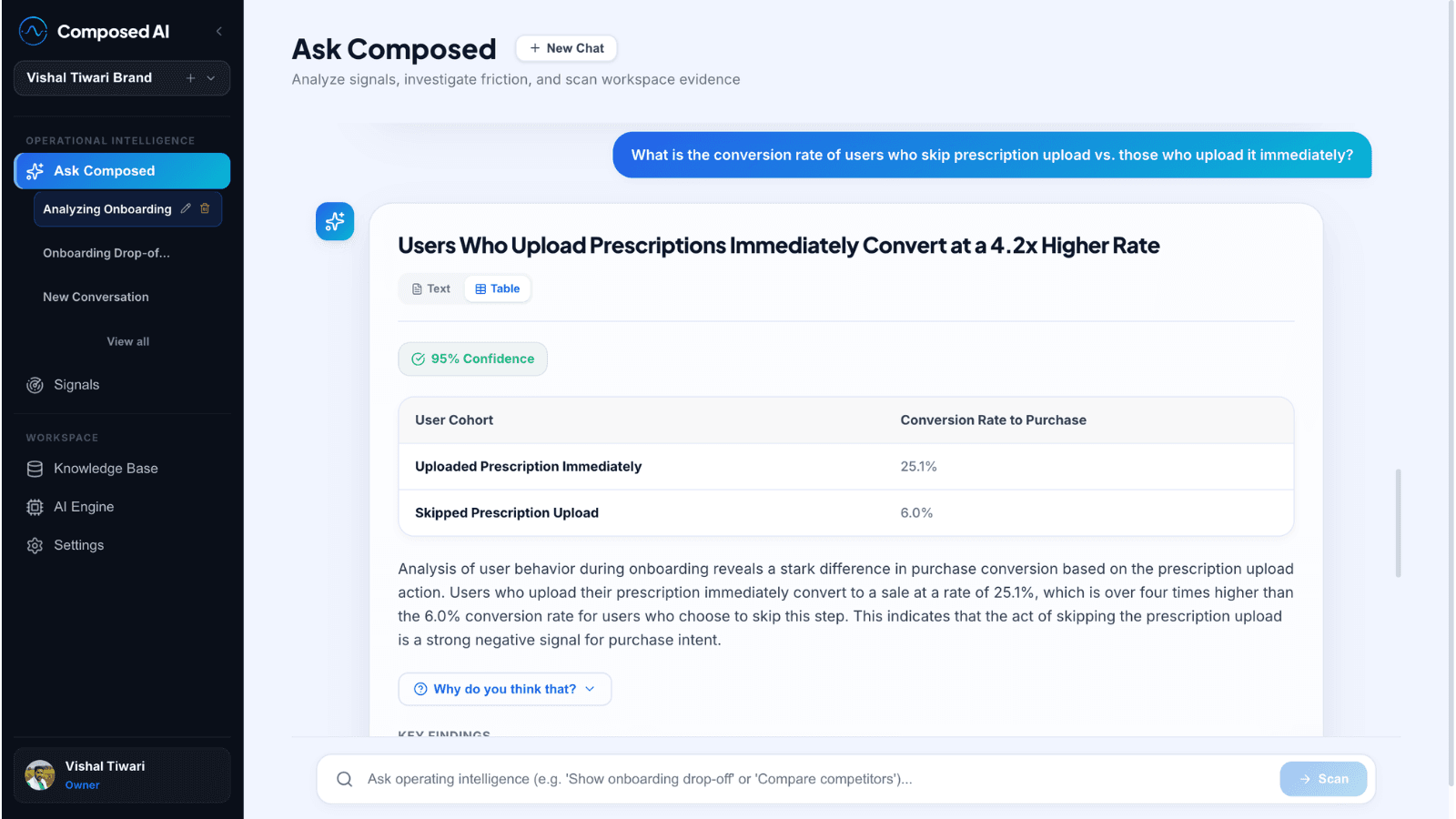
Every answer points back to what supports it.
Ask Composed does not produce plausible-sounding summaries. Every claim in a response is drawn from a specific record in your connected data. If a claim cannot be sourced, it is not included.
Your team can open any evidence item and read the original source — a specific support ticket, a paragraph from a document, a row in a database export, or a turn from a conversation.
Tickets, chat threads, emails
Events, records, pipelines
Policies, playbooks, FAQs
Funnels, sessions, cohorts
A question about your business reaches all of your data.
Most search tools query one source at a time. Ask Composed runs your question across all connected sources simultaneously — so the answer reflects the full picture, not just what was in one document.
When evidence from multiple sources points to the same conclusion, Ask Composed surfaces the convergence. When sources conflict, it flags the discrepancy and shows you both sides.
An investigation is not a single question. It is a dossier.
Ask Composed saves every investigation as a named, persistent thread. Your team can continue it, share it, compare it to past investigations, and trace every decision back through the reasoning that produced it.
Follow-up questions
Each question builds on the last. Ask Composed retains the context of your investigation thread, so follow-up questions do not start from scratch.
Conversation memory
The investigation thread remembers every question, answer, and piece of evidence from the current session. You can refer back to earlier answers in later questions.
Historical investigations
Every completed investigation is stored and searchable. When a signal reappears, you can open the prior investigation instead of starting over.
Compare investigations
Open two investigations side by side to compare how the same question played out at different points in time or across different data sources.
Investigation timeline
Each investigation shows a chronological log of questions asked, evidence retrieved, and decisions recorded — so the reasoning trail is always auditable.
Shared investigations
Investigations can be shared with any team member who has access. They can read the full thread, add follow-up questions, or branch a new investigation from the same starting point.
Questions teams bring to Ask Composed.
Each answer is sourced, cited, and saved for the team to act on.
Why did support volume spike in the last 14 days?
Volume increased by 34% after a configuration change on day 3. 67 of 108 new tickets cite the same integration error. The knowledge base does not document the expected behaviour for this configuration.
Which customers are most at risk of churning this quarter?
12 accounts on the Growth plan have had fewer than 3 logins in 30 days, have open unresolved tickets, and have not completed the core workflow in the last 45 days. 3 of these accounts had churn conversations in the last billing cycle.
What is driving pricing objections in pre-sale conversations?
The most common objection is the per-seat model, appearing in 41 of 63 reviewed conversations. Prospects frequently compare to a competitor offering a flat-rate price. The current pricing page does not address the comparison directly.
From question to saved investigation.
Every investigation follows the same structure. Nothing is skipped. Nothing disappears.
You ask a specific question about a signal, a trend, or a decision you need to make. Natural language — no query syntax required.
Ask Composed searches across all connected sources simultaneously — conversations, tickets, documents, and data records. It returns the specific records that answer your question.
The answer is constructed from the evidence. Each claim in the response is traced to a specific source. Nothing is inferred without a citation.
With evidence compiled and reasoning documented, your team has what it needs to make a confident call — or escalate to the right person.
The entire thread — questions, evidence, reasoning, and decision — is saved as a named investigation. Your team can return to it, continue it, or share it.
The full thread — questions, evidence, reasoning, and decision — is stored under a named investigation. Team members can open it, continue from where it left off, or reference it when the same issue resurfaces.