Signals are not alerts.
They are operating briefs.
Composed AI continuously reads your connected data sources and produces structured, evidence-backed briefs so your team knows exactly what to act on first.
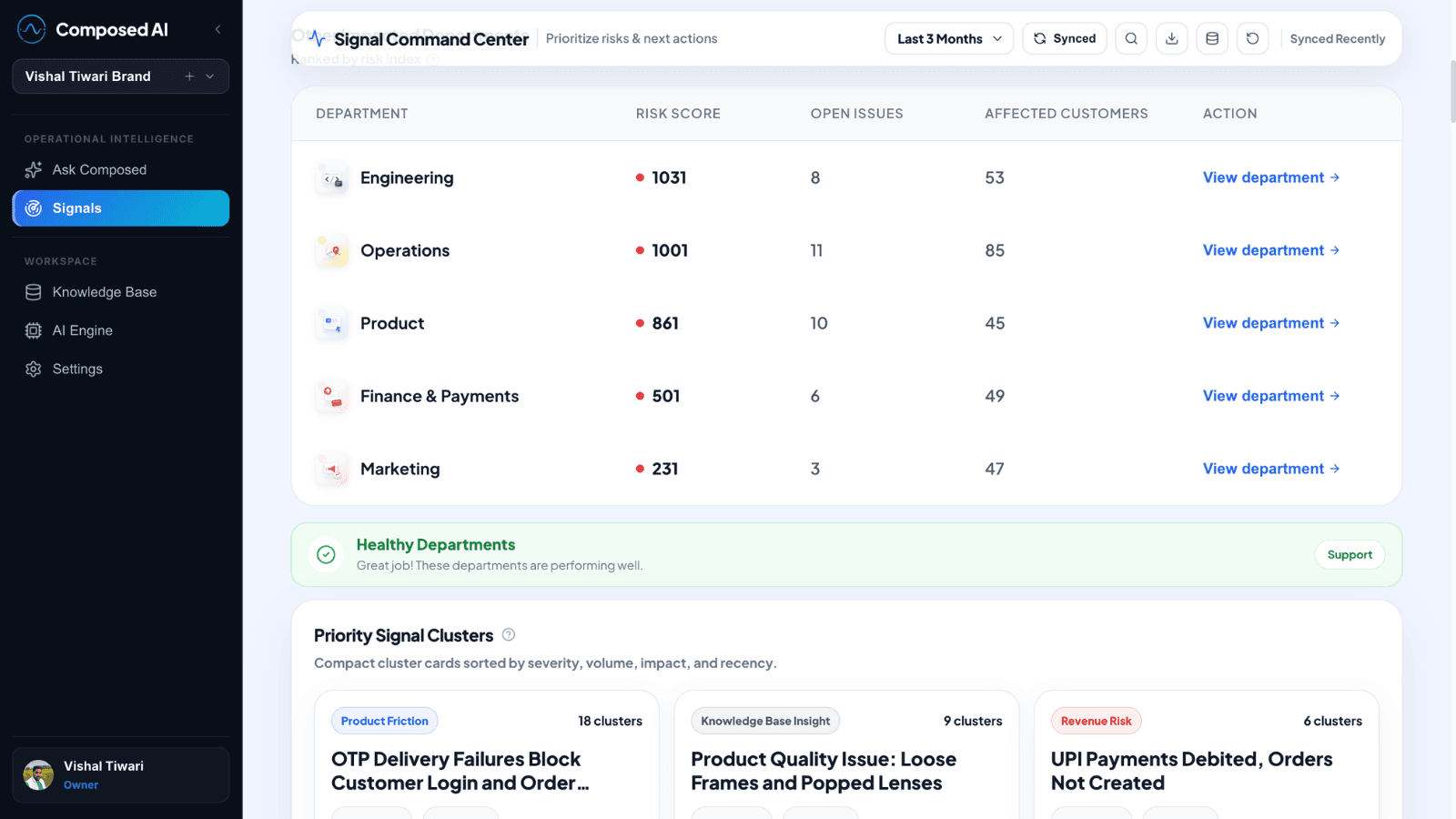
A Signal is a documented brief, not a ping.
DEFINITION
A signal is a structured brief produced from your business data. It identifies a pattern, compiles the evidence behind it, scores its business impact, assigns an owner, and proposes a next step — ready for your team to review and act on.
Every signal points back to what triggered it.
Composed AI does not produce summaries from thin air. Every signal includes the specific records, conversation excerpts, or data rows that support its conclusion.
Your team can open any piece of evidence and trace it directly to the original source — a specific ticket, a row in a database, a document paragraph, or a conversation thread. Nothing is inferred without a citation.
Specific turns from chat, email threads, and call notes that contain the pattern.
Sections from knowledge articles, policies, and playbooks referenced in the analysis.
Specific product events, CRM records, or database rows that support the conclusion.
Prior signals and resolutions that relate to the current pattern.
Repeated customer questions, unresolved contacts, escalation patterns
Activation drop-off, feature confusion, integration failures
Pre-sale pricing questions, objections, buying intent clusters
Messaging gaps, trial conversion friction, onboarding confusion
Fulfilment delays, policy violations, process breakdowns
Each signal goes to the team that can actually resolve it.
Most issues surface in support but get resolved in product, operations, or marketing. Composed AI routes each signal to the team whose work will fix the underlying cause — not just the team that saw the symptom first.
Routing rules are configured by your workspace admin. Admins define which signal types go to which teams, and who can reassign or escalate.
Signals measure what they cost, not just that they exist.
A signal without a business impact score is just a label. Composed AI measures each signal against real operational data to show you the scale of the problem.
How many records, customers, or events are affected by this pattern right now.
When this pattern first appeared and how recently new evidence has been added.
Whether the pattern is growing, stable, or declining compared to the previous period.
Estimated team time and contact effort attributable to this pattern based on your data.
Which customer tier, plan type, or cohort is most affected by this issue.
Signals are ranked so your team knows where to start.
The signal queue is sorted by a composite score. High-volume, recent, trending patterns that affect key customers appear at the top. Stable or low-volume patterns appear below.
Priority scores update continuously as new evidence arrives. A signal can move from Medium to Critical within a single ingestion cycle if volume spikes.
What a signal looks like in practice.
Each example below represents the format your team would see in the Discovery Layer queue.
Refund policy confusion driving repeat contacts
Customers are contacting support multiple times about the same refund question. The current policy page does not address the most common scenario. Each contact costs an average of 12 minutes of agent time.
Integration setup step blocking new account activation
Step 3 of the onboarding flow has a 38% drop-off rate. Users who reach this step and do not complete it rarely return. The drop-off pattern began 11 days ago and correlates with a configuration change.
Pricing questions appearing late in trial period
Prospective customers are raising pricing questions in the final 3 days of their trial rather than at the start. This suggests the pricing page is not visible enough during onboarding, and the questions are delaying decisions.
From raw data to a reviewed decision.
Signals do not appear instantly or disappear arbitrarily. They follow a defined lifecycle that your team can track from detection through to resolution.
Composed AI reads your connected data sources — conversations, tickets, documents, and records — on a continuous schedule.
Recurring themes, anomalies, and gaps are identified across multiple records. Single occurrences are filtered out.
Supporting records are attached to the signal. Each piece of evidence links to its original source.
Volume, recency, customer segment, and operational cost are used to score the signal's business impact.
Based on signal type and your routing rules, Composed AI assigns the signal to the correct team.
The assigned team reviews the brief, decides a next step, and marks it resolved. The audit trail is preserved.
DISCOVERY → INVESTIGATION
See a signal you need to understand better?
Every signal in the Discovery Layer can be opened directly in Ask Composed. From there you can ask follow-up questions across all your connected data, explore the evidence in depth, and build a persistent investigation thread your team can return to.
Investigate this Signal with Ask Composed