Signals your teams should act on first.
Composed AI turns support, product, knowledge, and analytics data into prioritized signals with evidence, ownership, and recommended next steps.
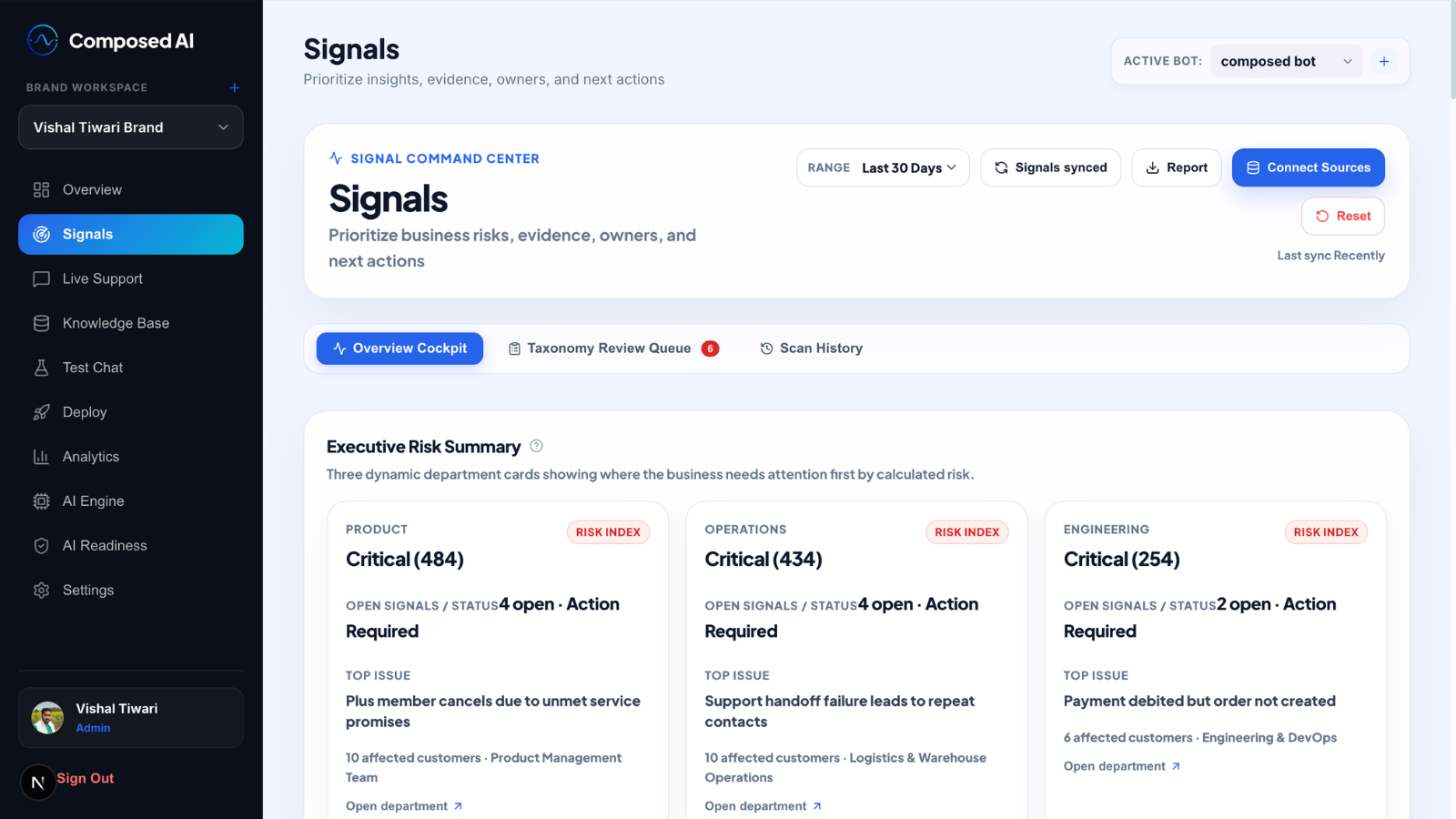
Signals from every source your business already uses.
Connect conversations, documents, tickets, feedback, product events, and operational records to detect what needs attention.
Customer conversations
Sync chats, emails, tickets, call notes, and support logs to capture signals in real time.
Knowledge and documents
Upload help docs, policies, playbooks, PDFs, and unstructured business guides.
Product analytics events
Connect database tables or event streams to monitor behavior changes and funnel movement.
All sources run simultaneously. Signals appear in one unified queue.
Not a summary. A rigorous extraction pipeline.
Composed AI doesn't ask a generic AI model to summarize your conversations and call it intelligence. Every source runs through a structured pipeline designed to generate defensible, actionable signals — not guesses.
Raw Source
Business data enters from database syncs, uploaded files, or interaction logs.
Prefilter
Noise removal, relevance scoring, duplicate cleanup, and source preparation.
RAG Grounding
Cross-referenced against verified business knowledge bases.
AI Extraction
Structured pattern identification extracts problems, intent, friction, and impact.
Embeddings & Hybrid Clustering
Semantic grouping across sources, time periods, and related customer evidence.
Prioritized Signal
Ranked by volume, impact, recency, and team ownership.
Every signal comes with evidence, a priority score, a recommended owner, and a suggested next action — ready for your team to review.
What Composed AI detects automatically.
Repeated user patterns
Repeated questions or queries clustering across data sources, ranked by frequency and volume. A reliable signal of product or messaging gaps.
Data & Knowledge gaps
Areas where your business records or docs lack coverage for critical queries — flagged before they lead to workflow escalations.
Escalation anomalies
Database entries or conversations that triggered handoffs or failure states, grouped by root cause and volume to detect underlying system bugs.
Product and policy friction
Where users repeatedly run into friction with pricing, billing, or system workflows. A pattern extracted from multiple connected sources.
Revenue signals
High-intent buying patterns, demo interest, or expansion signals detected automatically in data source logs before they churn.
Operational anomalies
Fulfillment delays, sync failures, or delivery bottlenecks spotted in business data logs before operational queues are impacted.
A prioritized work queue for every team.
Signals from all your data sources appear in one unified queue — grouped, ranked, and organized so your team sees what needs attention and who should own it.
Admins control which teams can view signals and which roles can take actions. Access is set by role, signal type, or severity.
Every signal explains the pattern behind the problem.
Not just a flag. A full analysis — what happened, why it matters, who owns it, what to do next, and the evidence mapped directly from your connected business data sources.
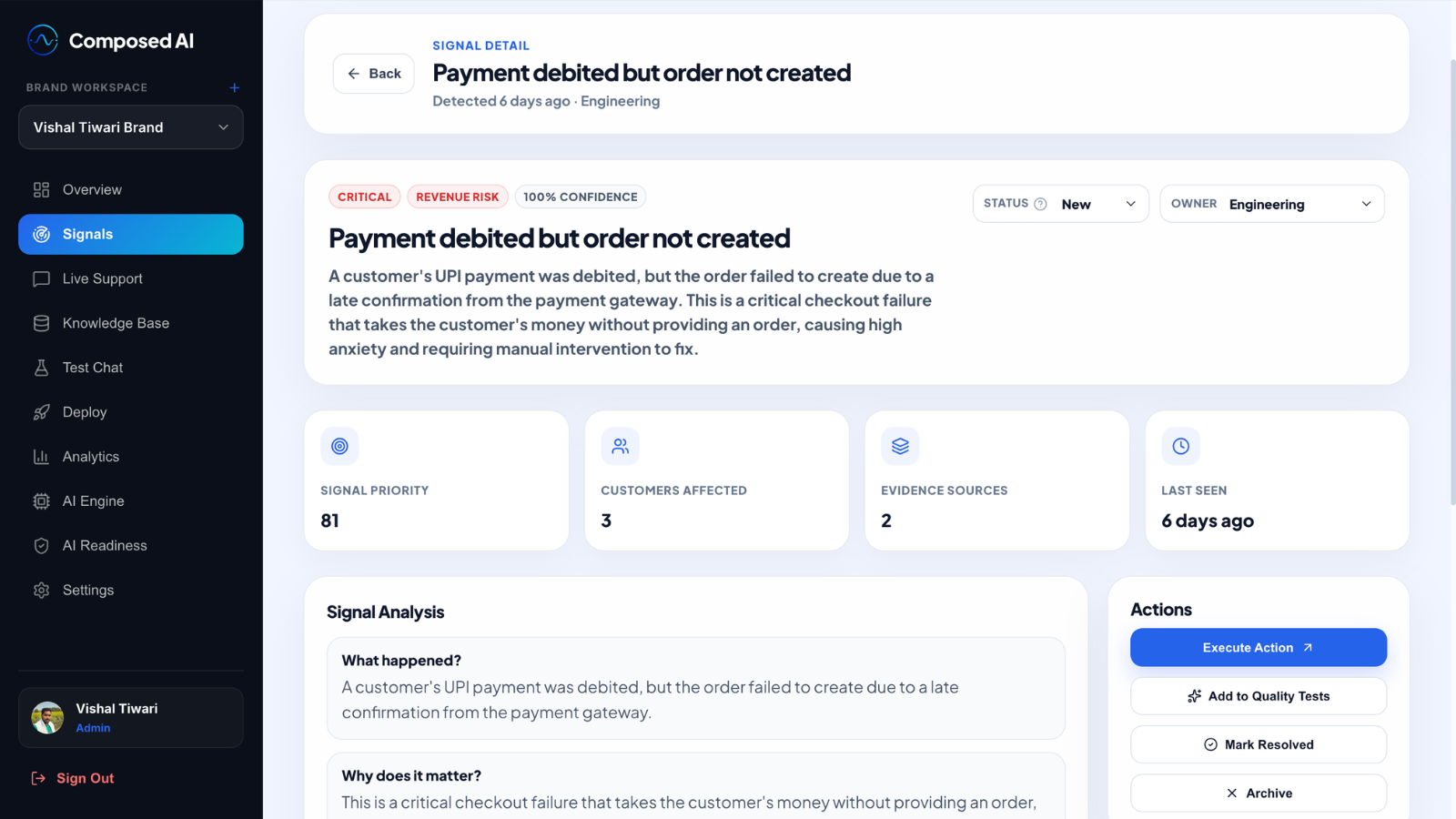
Priority score calculated from volume, revenue impact, and recency
Evidence linked directly to matching records and source data
Recommended owner and action suggested automatically
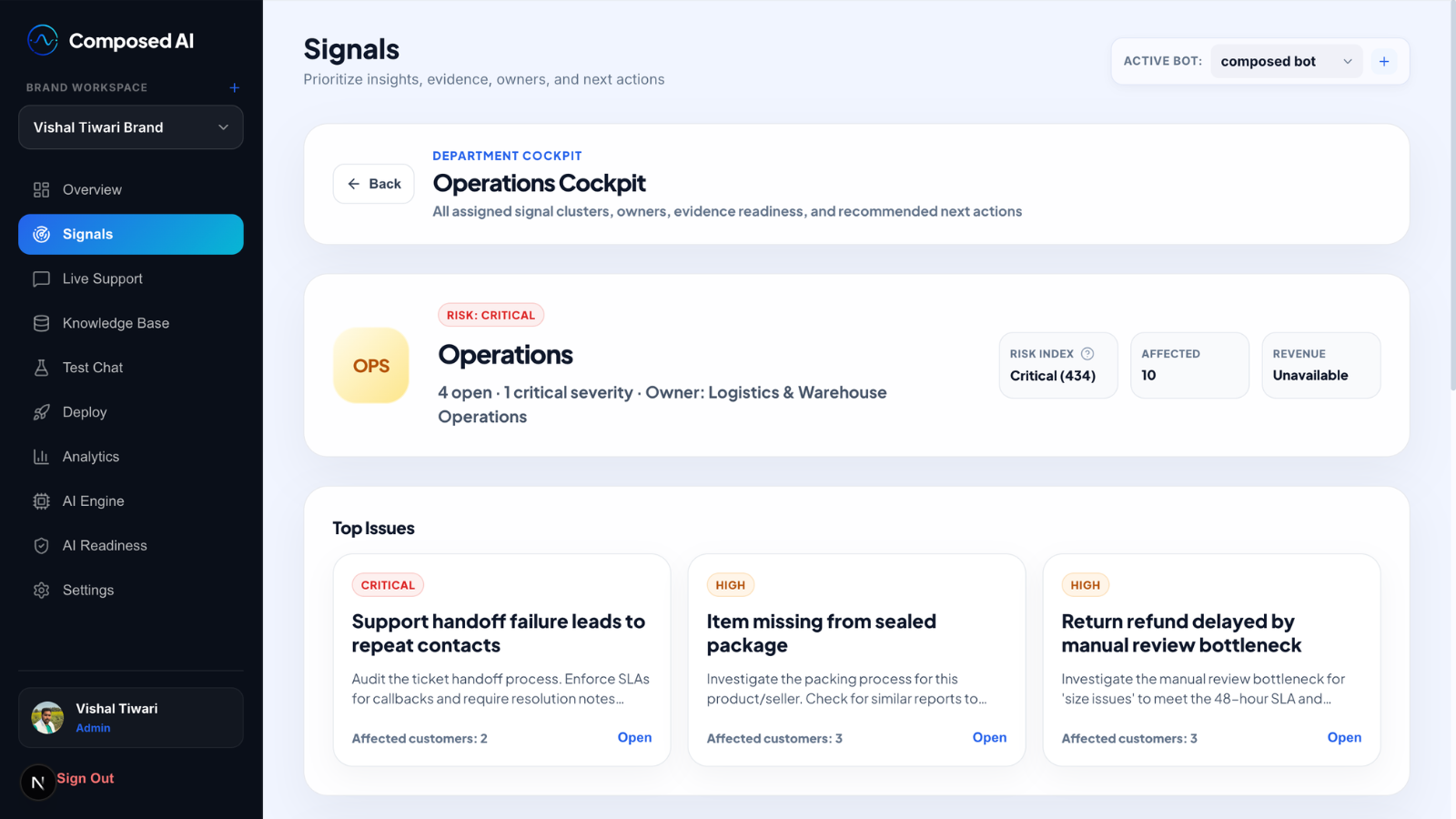
Every signal reaches the team that owns it.
Signals don't all go to support. Each signal is assigned to the team that can act — with its own cockpit, evidence queue, and priority view.
Repeated questions about billing schedules
→ Operations
Action: Update knowledge documentation and auto-routing policies
Feature requests clustering in database logs
→ Product
Action: Evaluate against roadmap priorities; validate volume with evidence
Pricing objections detected in signup records
→ Sales
Action: Review landing page pricing positioning; update sales enablement
Teams stop reading every transcript manually and start acting on prioritized patterns.
Support
Unresolved queries, failed resolutions, repeated complaints, and handoff patterns
Product
Feature confusion, broken workflows, unexpected use cases, friction
Sales
Buying intent, pricing questions, comparison objections, demo requests
Operations
Fulfillment errors, delivery delays, process breakdowns, policy friction
Marketing
Messaging gaps, positioning confusion, and pre-sale objections
Signals improve your intelligence and your decisions.
Each loop makes your data intelligence more precise and your team faster to respond.
From signals to approved actions.
Signal generation is available today. The next layer is controlled action — creating tickets, drafting replies, recommending knowledge updates — with approval workflows, audit logs, and rollback paths. Actions happen only when a human approves them.
Approved actions are in development. Everything above is available today.